Accelerating Drone-Based Object Detection with SAAB
Discover how Embedl and SAAB enhanced drone object detection through advanced AI model optimization, achieving real-time performance without sacrificing accuracy on constrained hardware.
2 min read
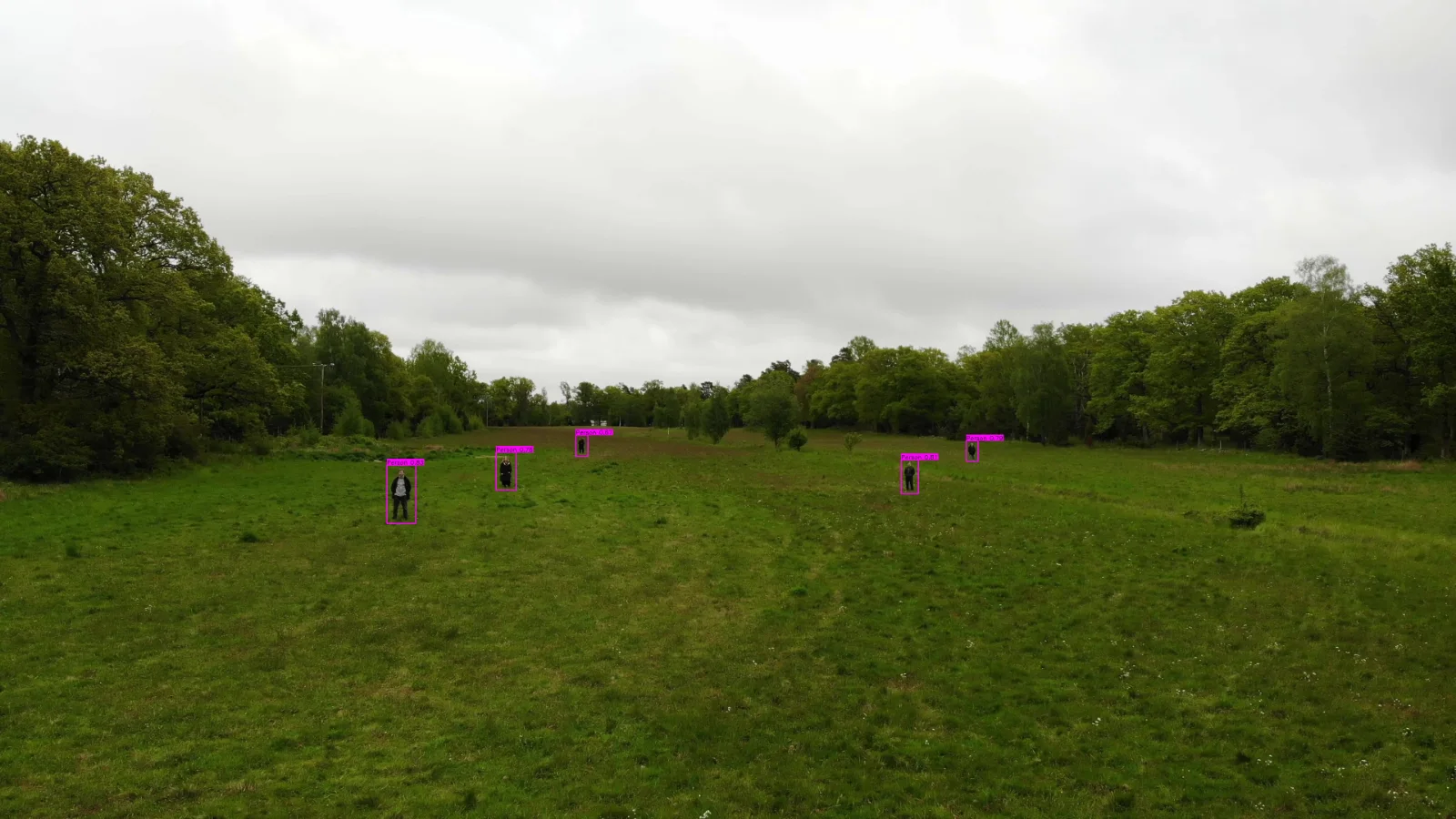
Real-Time Drone Object Detection
In a research collaboration, Embedl partnered with SAAB, a global leader in defense and security solutions, to advance the capabilities of drone-based object detection systems. The project's objective was to explore high-performance, real-time inference of deep learning models on edge devices—specifically, drones.
The joint effort focused on optimizing and deploying an object detection model that can operate efficiently under the computational constraints typical of unmanned aerial vehicles (UAVs).
Roles and Responsibilities
- Embedl was tasked with model training and optimization, ensuring the object detection model could run effectively on limited hardware while maintaining accuracy.
- SAAB was responsible for deploying and integrating the optimized model into the drone platform, validating its performance in real-world scenarios.
Technical Challenges
Deploying object detection models on drones presents several challenges:
- Limited computational resources on embedded platforms.
- Strict power and latency constraints, especially in autonomous or semi-autonomous settings.
- Preserving accuracy after optimization and despite hardware constraints.
Solution and Approach
Embedl leveraged its expertise in model optimization to compress and accelerate the object detection network. Key steps included:
- Model quantization to reduce computational load.
- Iterative performance tuning was used to ensure the model met the required speed and memory constraints.
On SAAB’s side, the optimized model was integrated into the drone’s onboard systems, where real-time object detection was essential for tasks such as navigation, surveillance, and mission-specific operations.
Results
The collaboration delivered impressive results:
- The use of quantization for inference optimization led to a 2.26× speedup in runtime performance.
- Accuracy was maintained, with no measurable drop despite the optimization—a critical factor for mission-critical applications.
- The improved performance enabled the drone to process real-time video feeds more efficiently, enhancing responsiveness and autonomy.
Impact and Future Work
This project validated the feasibility of deploying advanced AI models on drones without compromising performance or accuracy. It also highlighted the importance of cross-disciplinary collaboration, combining deep learning optimization with domain-specific deployment expertise.
The success of this initiative lays the groundwork for future collaborations aimed at pushing the boundaries of edge AI, particularly in aerospace, defense, and surveillance applications.
Conclusion
The Embedl-SAAB collaboration demonstrates how efficient model optimization can dramatically enhance the performance of AI systems on constrained hardware.