Skip to content

Embedl Deploy

Build deployable physical AI models

Eliminate hardware compatibility issues and late-stage compilation failures. Design, optimize and quantize in PyTorch; deploy with confidence on the edge.

Shell
pip install embedl-deploy
View on GitHub Book a demo
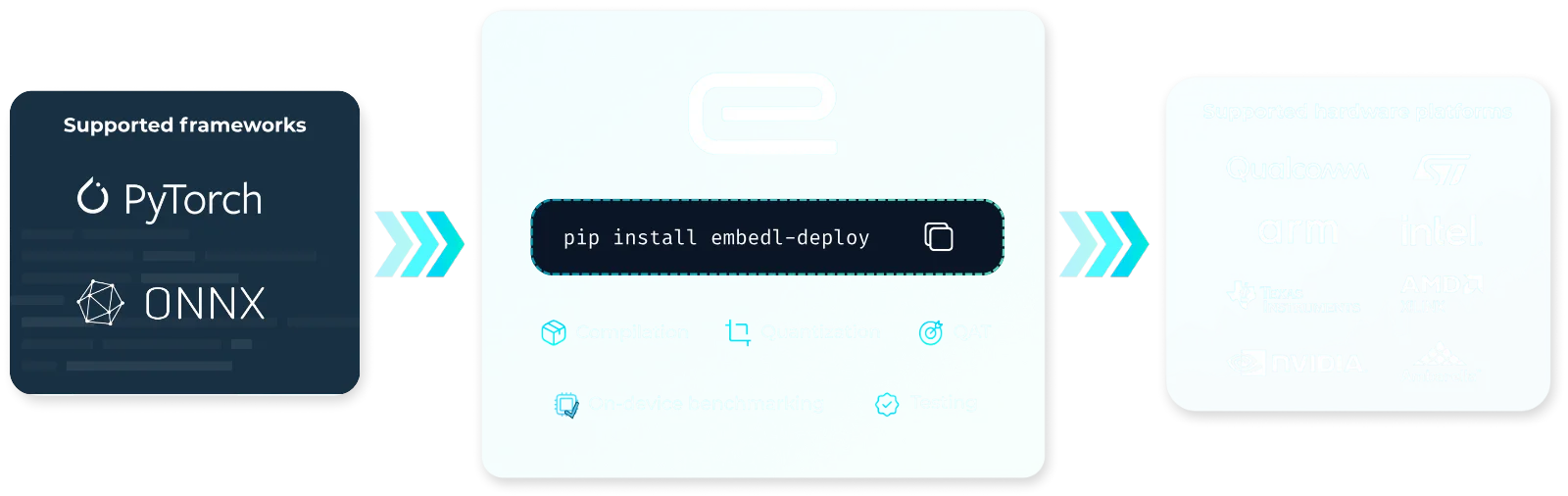
From PyTorch through Embedl Deploy to ONNX and the device toolchains

AI deployment challenges

Python is flexible; hardware is not

Models are complex

Graph tracing breaks on complex models with dynamic control flow.

Models fail to export reliably.

Unsupported operations

Hardware toolchains have strict operator restrictions, e.g. no ReLU6.

Unsupported operators mean rewriting models by hand after design.

Hidden graph conversions

"Black box" compilers convert models unpredictably.

Debugging deployment issues gets complicated.

Quantization pitfalls

Incorrect quantization breaks operator fusions.

Poor quantization causes severe performance bottlenecks.

The Embedl Deploy solution

Hardware constraints, enforced in PyTorch

A Python toolkit that makes AI models meet hardware constraints by enforcing them in PyTorch, before the vendor compiler runs.

A PyTorch-native workflow

Apply graph rewrites, operator fusion, hardware-aware quantization and mixed-precision quantization to the PyTorch model before compilation.

  • Compiler constraints and operator fusions enforced during model design, or transformed automatically
  • No added dependencies other than PyTorch
Python
from embedl_deploy import transform
from embedl_deploy.tensorrt import TENSORRT_PATTERNS

# Apply hardware-aware fusions and conversions
fused = transform(model, TENSORRT_PATTERNS).model

Quantization, optimized

Hardware-aware QDQ placements for the best accuracy and performance. Apply post-training quantization (PTQ) or quantization-aware training (QAT) with embedl-deploy.

  • Explicit quantization for every fused pattern and module
  • What you design and build in PyTorch is what runs on hardware
Python
from embedl_deploy.quantize import quantize

ptq_model = quantize(
    fused,
    (example_inputs,),
    quant_config,
    calibration_loop,
)

See what changed

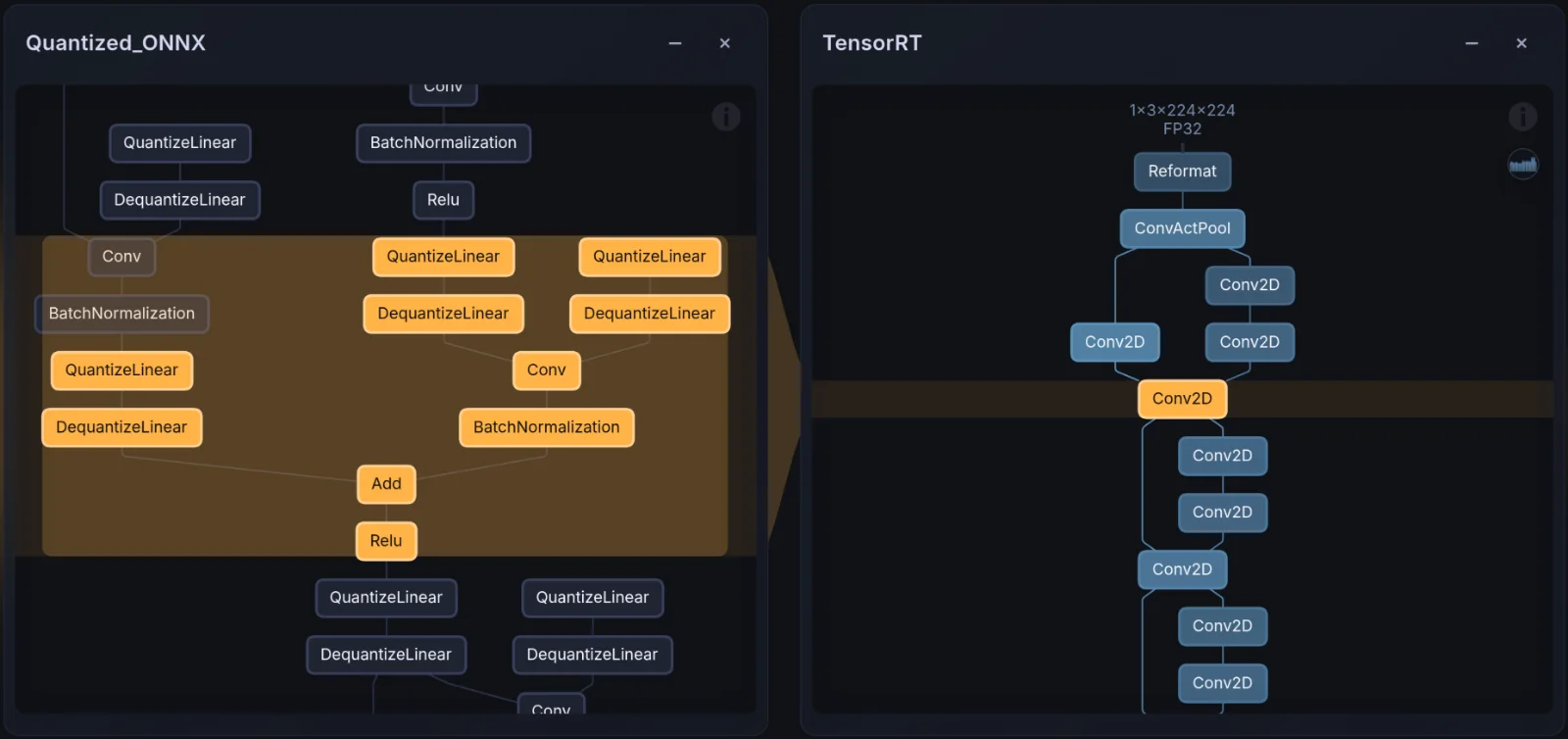
Compare graphs across compilation stages: PyTorch models, ONNX models, or compiled graphs parsed from TensorRT layer info files.

A PyTorch graph mapped to the compiled TensorRT graph

Hardware backends

Built for edge deployment

No more vendor-specific compilation and quantization errors: no late-stage failures, easier debugging.

NVIDIA
NVIDIA TensorRT

Automates TensorRT integration by identifying and replacing unsupported operators before compilation. Prevents runtime failures and unexpected graph fusions on Jetson and Orin platforms.

Texas Instruments
Texas Instruments TIDL

Manages TIDL-specific quantization and memory alignment. Prevents silent failures and accuracy drops caused by automatic operator substitution in the TI compiler toolchain.

FAQ

Frequently asked questions