Lightning-Fast Multimodal Edge Inference with Under 8GB RAM
Embedl is releasing Cosmos Reason2 with FlashHead, a new optimized model that delivers fast multi-modal reasoning on devices with less than 8GB of RAM while maintaining strong reasoning performance.
Embedl · · 3 min read
Running advanced multi-modal reasoning models on edge hardware has traditionally required large GPUs and tens of gigabytes of memory. Today, Embedl changes that. We’re releasing Cosmos Reason2 with FlashHead, a new optimized model that delivers fast multi-modal reasoning on devices with less than 8GB of RAM while maintaining strong reasoning performance.
By combining our Edge2 mixed-precision quantization with FlashHead, our new ultra-efficient output head, we remove major compute and memory bottlenecks in the inference pipeline. The result is a state-of-the-art multi-modal reasoning model that runs faster than previous Cosmos Reason2 deployments, enabling real-time reasoning for robotics, edge AI systems, and interactive applications on compact hardware.
Quick background: Cosmos Reason 2 and Quantization
Cosmos Reason2 is a multimodal reasoning VLM (text + image/video → text) based on Qwen3-VL, designed for physical AI workloads where latency and memory bandwidth often matter more than peak datacenter throughput.
With W4A16‑Edge2, we showed by keeping a small, carefully selected set of sensitive layers in FP16 while quantizing aggressively elsewhere, we can recover most of the baseline-level reasoning accuracy while maintaining the deployment gains of W4A16.
On Jetson AGX Orin (batch size 1), W4A16‑Edge2 more than halves end-to-end latency across text/video/image workloads.
So what’s left to optimize?
The next bottleneck: the dense output head
Even after you quantize the transformer body, a major cost often remains:
The dense classification / LM head; the output layer that converts hidden states into token probabilities.
In modern language model architectures (Llama‑3.2, Gemma‑3, Qwen‑3, etc.), the output head can account for 20–60% of parameters and up to 50% of compute time, and its cost scales directly with vocabulary size (Blog: Ultra-Efficient SLMs). For edge deployments, that’s exactly the wrong place to waste compute.
FlashHead replaces the traditional dense head with a retrieval-style, multi-stage architecture, inspired by information retrieval rather than a “giant matrix multiply.”
Why Cosmos Reason2 + FlashHead is faster
W4A16‑Edge2 already optimizes the transformer body by mixing INT4 weight quantization with FP16 retention in sensitive layers.
Cosmos Reason2 + FlashHead extends the optimization to the final-stage token selection path, turning a repeated per-token bottleneck into a much lighter operation, exactly where decoding latency accumulates.
In other words:
- W4A16-Edge2: Quantization without sacrificing reasoning quality.
- FlashHead: Removes the output-head bottleneck that quantization alone cannot eliminate.
- Combined: Lower latency with FlashHead while preserving Edge2’s accuracy.
Benchmarks
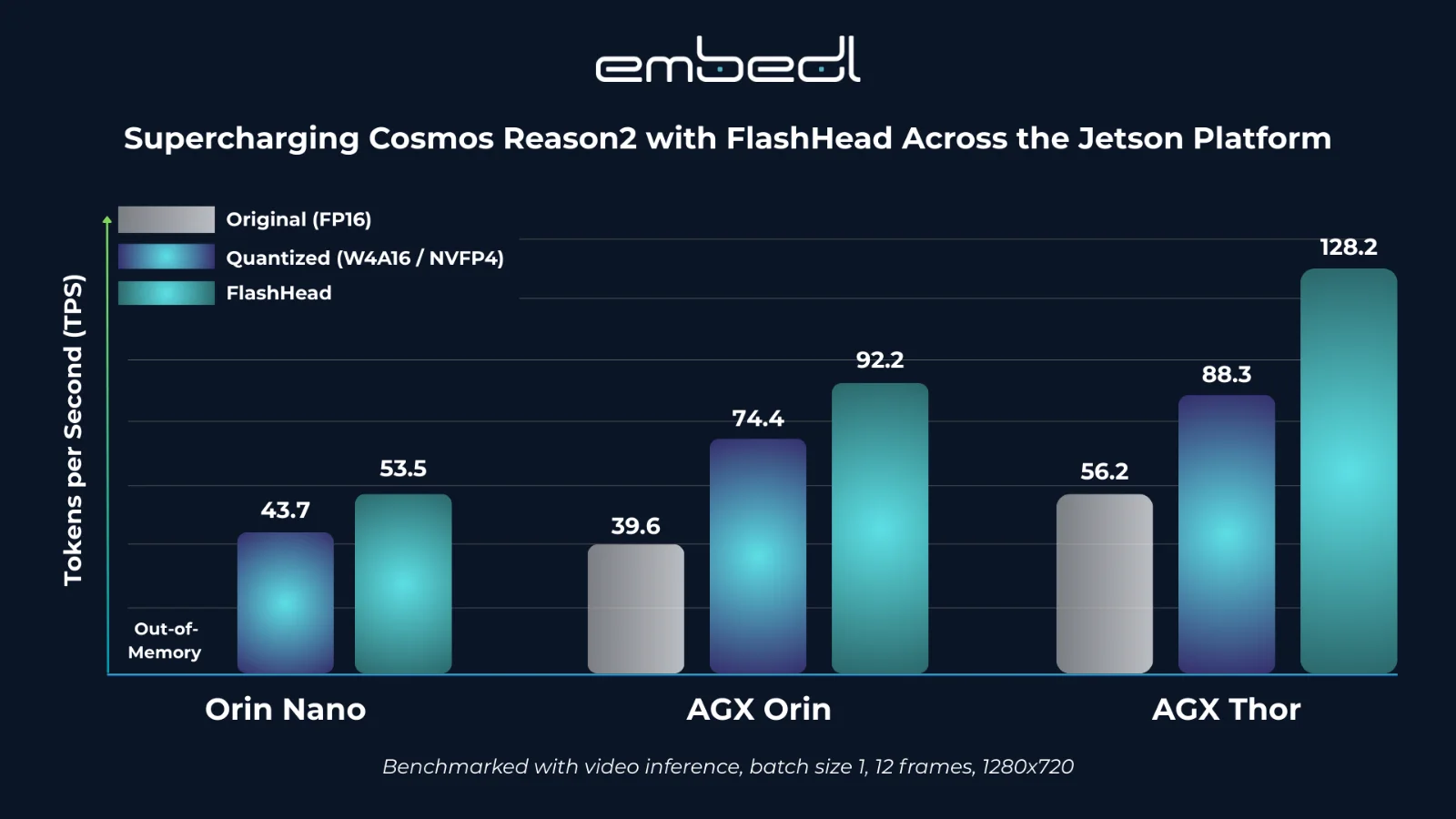
W4A16-Edge2 was designed to preserve the reasoning accuracy of the original unquantized model. FlashHead targets the remaining bottlenecks in the output head. Combined with W4A16-Edge2, it further reduces latency while maintaining the same accuracy.
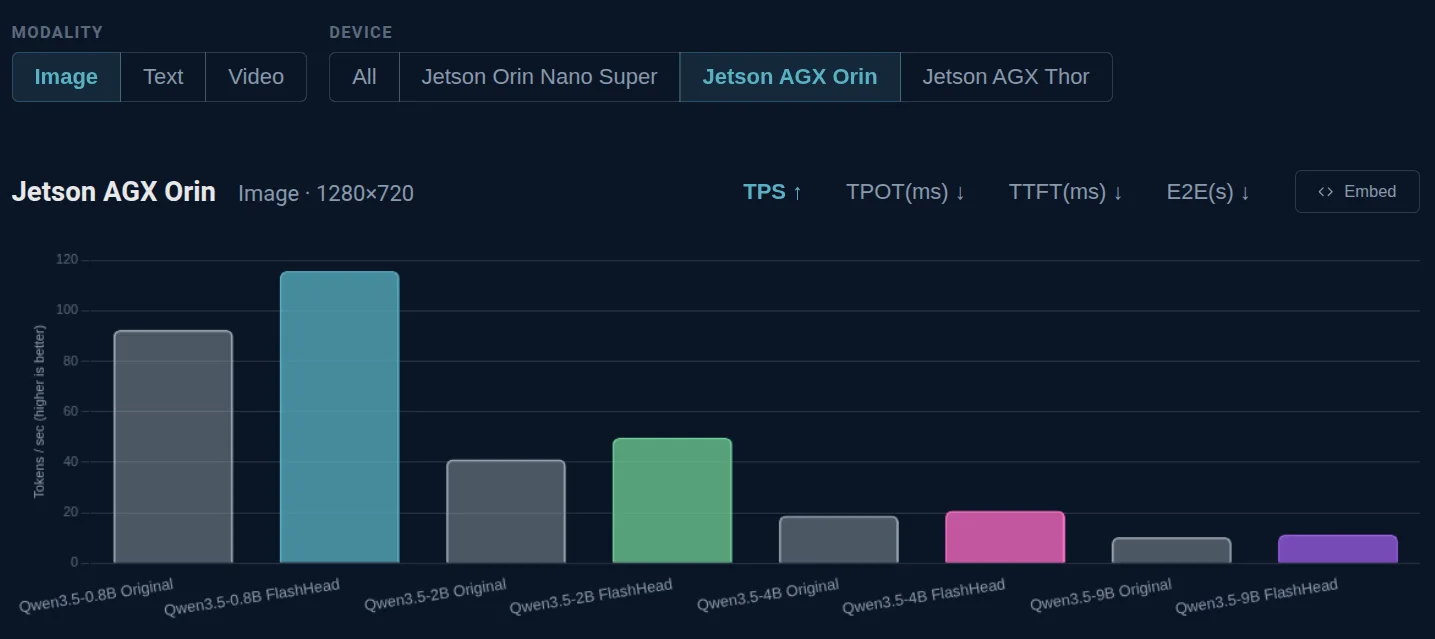
Below is a table of inference speed (tokens per second) over all possible modalities. More details on benchmarks can be found here.
| Device | Modality | Original (FP16) | W4A16-Edge2 | W4A16-Edge2-FlashHead |
| Orin Nano Super | text | OOM | 56.96 | 75.33 |
| Orin Nano Super | image | OOM | 42.33 | 51.84 |
| Orin Nano Super | video | OOM | 43.62 | 53.48 |
| AGX Orin | text | 45.55 | 99.84 | 132.52 |
| AGX Orin | image | 26.47 | 71.94 | 85.90 |
| AGX Orin | video | 39.58 | 74.93 | 92.21 |
| AGX Thor | text | 65.20 | 116.43 | 189.16 |
| AGX Thor | image | 52.96 | 87.42 | 117.38 |
| AGX Thor | video | 56.22 | 90.03 | 128.15 |
How to run it
Recommended runtime path
Test on hardware with minimal setup
docker run --rm -it \
  --network host \
  --shm-size=8g \
  --ulimit memlock=-1 \
  --ulimit stack=67108864 \
  --runtime=nvidia \
  --name=vllm-serve \
  -e HF_TOKEN=hf_*** \
  -e HF_HOME=/root/.cache/huggingface \
  embedl/vllm:latest-jetson-orin-flashhead \
  vllm serve "embedl/Cosmos-Reason2-2B-W4A16-Edge2-FlashHead" \
  --max-model-len 8192 \
  --gpu-memory-utilization 0.75 \
  --max-num-seqs 2 \
  --trust-remote-code
Why this matters for Physical AI
As physical AI systems move from prototypes to deployed robots and autonomous vehicles, two constraints dominate:
- Can it run on target hardware?
- Is it responsive enough to be useful in real time?
W4A16‑Edge2 established that Cosmos Reason2 can meet strict edge memory + latency constraints without giving up benchmark-level reasoning quality.
Cosmos Reason2 + FlashHead is the next step: it targets the part of the inference loop that still repeats at every token, the output head, and removes it as a practical bottleneck.
Try it now
Hugging Face model link
Edge Inference Benchmarks page